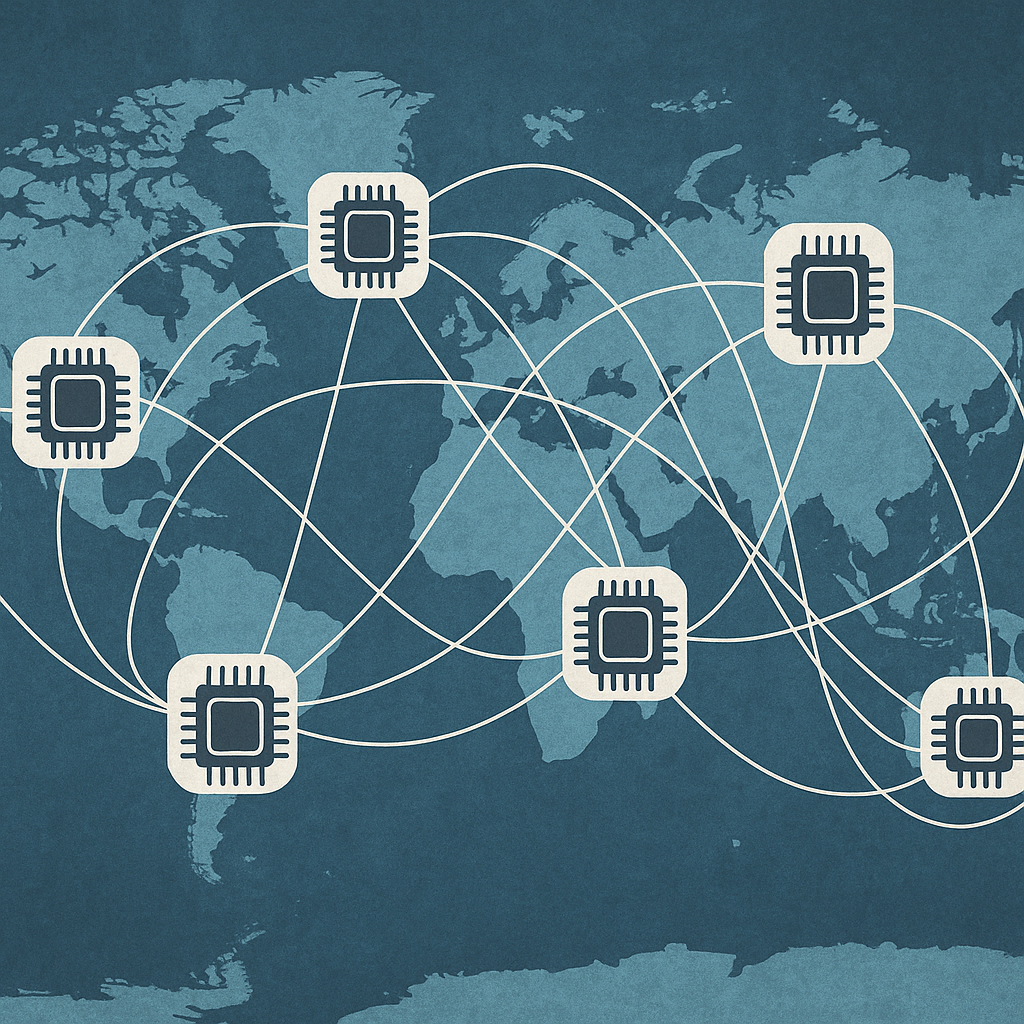
Explore how the global semiconductor supply chain shapes innovation and economic development while navigating complex vulnerabilities and risks.
On January 15 (US Eastern Time), Taiwan and the United States concluded a wrap-up meeting on their bilateral trade talks, reaching consensus on multiple key issues. The outcomes include: applying a reciprocal 15% cap on Taiwan’s tariff rate without stacking it on top of existing Most-Favored-Nation (MFN) tariffs; securing the most favorable possible treatment for semiconductors and related products under Section 232 tariffs; expanding bilateral investment and cooperation across supply chains; and deepening the strategic partnership in AI and other high-tech sectors. Taiwan indicated that once the written trade agreement completes legal review, it will be submitted to the Legislative Yuan in accordance with due process, ensuring that the pact advances under robust legal and democratic oversight.
The talks were led on the Taiwan side by Vice Premier Cheng Li-chun and chief trade negotiator Yang Jenny from the Office of Trade Negotiations, while US Secretary of Commerce Lutnik and US Trade Representative Greer headed the American delegation. Both sides also witnessed the signing of an investment cooperation memorandum of understanding between the Taipei Economic and Cultural Representative Office in the United States and the American Institute in Taiwan at the US Department of Commerce, signaling that Taiwan–US economic and trade cooperation is moving from policy consultation toward more concrete investment and industrial implementation.
On tariffs, both sides confirmed that Taiwan’s reciprocal tariff rate will be capped at 15% and calculated without layering on MFN tariffs. This is expected to reduce uncertainty in export costs, enabling companies to sign longer-term contracts, schedule production with greater confidence, and expand order intake, while making Taiwan’s exports more competitive and on a more level footing in the US market. For Taiwanese Americans, this kind of institutional “predictability” tends to translate into more stable demand, more local operations, and expanded opportunities for outsourced services—especially in 3C products, components, and supply-chain-adjacent industries, where employment and project-based work are poised for further growth.
On Section 232 and semiconductor issues, the two sides agreed to a framework that links tariff treatment to the structure of investment, aiming to secure more favorable conditions for semiconductors and related products. They also set out clearer policy guidelines for the import and export of raw materials, equipment, and components needed for Taiwanese firms to build and operate plants in the US. The core objective is to reduce the risk companies face from policy shifts, increase predictability in supply chain planning and capital expenditure, and preserve room for continued consultations as the scope of covered products potentially expands. For Taiwanese Americans, clearer tariffs and compliance pathways make it easier to contribute professionally in areas such as tariff classification, rules of origin, import–export documentation, compliance procedures, and supplier qualification, building stable and replicable service capabilities.
In terms of supply chain cooperation, both sides are promoting a “Taiwan model” to guide companies into the US supply chain—leveraging industrial clusters and vertical integration to accelerate localization and enhance the global competitiveness of technology industries. This implies that demand will extend far beyond manufacturing itself, spilling over into project management for plant construction, facility and EHS operations, safety audits, logistics and warehousing, equipment maintenance and calibration, systems integration, cybersecurity compliance, talent development, and outsourced operations. Taiwanese Americans, with their long-standing cross-cultural and cross-regulatory communication skills, can position themselves as “translators” between the two supply chains—helping connect Taiwan’s efficiency in production with US regulatory requirements, state-level resources, and local partners, and thus becoming indispensable bridges in the localization process.
On AI and broader high-tech strategic collaboration, the two sides agreed to build a closer AI supply chain partnership based on mutual investment and complementary strengths. The US brings advantages in R&D, talent, and market size, while Taiwan offers manufacturing prowess and supply chain integration. A more institutionalized rhythm of cooperation in technology, capacity deployment, and market entry is expected to help both sides consolidate their leadership in the global technology landscape. For Taiwanese Americans, this is not just industry news but a tangible career and entrepreneurial window: AI supply chain expansion will drive long-tail demand from hardware, data centers, and networking to cybersecurity and enterprise systems integration. Because Taiwanese Americans often understand both Taiwan’s manufacturing base and the US market front, they naturally possess an “end-to-end” perspective across this value chain.
Facing this new landscape, overseas Taiwanese communities and Taiwanese Americans need not simply observe these favorable trends from the sidelines; they can actively turn them into concrete outcomes. First, Taiwanese Americans can quickly inventory their own expertise and package it into services that can be clearly procured—whether in engineering, supply chain, procurement, finance and legal, customs and logistics, or IT, cybersecurity, and data governance—articulating deliverables in quantifiable terms so enterprises can rapidly engage them during expansion. Second, community organizations can leverage chambers of commerce and professional networks to build a “local resource map,” systematically cataloging suppliers, talent networks, compliance consultants, equipment maintenance, and logistics and warehousing resources to form the support infrastructure most needed when new industrial clusters take root. Third, Taiwanese Americans should proactively strengthen their grasp of Section 232, export controls, rules of origin, and tariff classification, and prioritize building SOPs for trade and compliance, recognizing that the true determinant of successful market entry is not slogans but the smooth functioning of operational details. In addition, they can leverage the strengths of US institutions to help companies access state-level incentives, tax benefits, land and infrastructure coordination, local partners, and recruitment channels—turning “speed of localization” into a competitive edge. For investors and entrepreneurs, dissecting the supply chain into segments such as construction, equipment, materials, logistics, systems integration, and operations—rather than chasing only the most upstream headlines—can help distribute risk and build resilience around long-term demand. Finally, because the agreement still requires legal review and legislative procedures, Taiwanese Americans can bring professional insight to public discussions, clearly explaining the concrete impacts on jobs, supply stability, and technology cooperation, thereby reducing polarized debate and strengthening public understanding and support for industrial policy.
The government emphasizes that Taiwan–US economic and trade cooperation is entering a more concrete phase of investment and industrial implementation. If Taiwanese Americans can convert their bilingual, bicultural, and dual-regulatory advantages into marketable professional services, local organizing capacity, and on-the-ground supply chain solutions, they will be well positioned to gain real career advancement, entrepreneurial opportunities, and community influence in this new era of Taiwan–US cooperation, and to help transform the complementary strengths of the bilateral high-tech supply chain into durable, shared growth momentum.